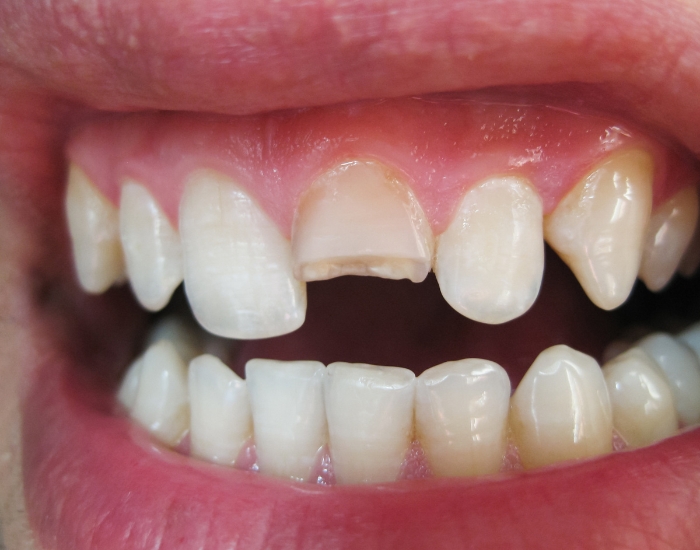
An impacted canine tooth is a permanent canine, or eye tooth, that stays partly or fully trapped under the gum or in the jawbone instead of coming in normally; it is usually found on X-rays and treated by monitoring, making space, surgically exposing and guiding the tooth into place, or removing it. Walk-In Dental Clinic at 20919 Kingsland Blvd in Katy is open 7 days a week and evaluates impacted teeth for patients from Katy, Cypress, Fulshear and Greater Houston.
An impacted canine can affect both oral health and the look of your smile if it is not treated. Canine teeth play a key role in biting, chewing and guiding how the other teeth fit together. When one or both canines fail to come into the right position, the result can be pain, infection or long-term bite problems. Understanding the symptoms, causes and treatment options helps families get timely care and avoid complications.
- Impacted canines are most common in the upper jaw and are often spotted on X-rays in early adolescence.
- Signs include a baby canine that will not fall out, a missing adult canine, gum swelling or a bump, and shifting teeth.
- Crowding, abnormal tooth angle, extra teeth, retained baby teeth and genetics are common causes.
- Untreated impacted canines can damage neighboring roots, cause infection or form cysts.
- Treatment ranges from monitoring and orthodontics to exposure and bonding or extraction.
What is an impacted canine tooth?
An impacted canine is a canine tooth that does not erupt properly through the gum and remains partly or fully trapped in the jawbone. It is one of the most common impacted teeth after wisdom teeth.
Canines, also called cuspids or eye teeth, sit between the incisors and the premolars. They have the longest roots in the mouth and help keep the bite balanced and guide the jaw when you close. Impacted canines show up most often in the upper jaw and usually develop during the preteen and teen years. In many cases the tooth is there but blocked by other teeth, dense bone or a lack of space in the dental arch. Without treatment, it can interfere with nearby teeth and overall oral health. Learn more about these teeth in our guide to the canine (cuspid) tooth.
What are the common symptoms of an impacted canine?
The most common sign is an adult canine that has not come in long after the other adult teeth, often with a baby canine still in place; some people also have gum swelling, tenderness or a dull ache in the upper jaw. Many impacted canines cause no symptoms at all.
- A baby canine that is still in place in the early to mid teens
- No adult canine visible long after neighboring adult teeth have come in
- A firm bump on the roof of the mouth or high on the gum above the front teeth
- Swelling, tenderness or sensitivity in the gum near the canine area
- Pressure or a dull ache in the upper jaw
- Front teeth that shift, tip, crowd or develop gaps
- Occasional pain spreading toward the nose or eye area
Because the tooth is hidden, impacted canines are often found on routine dental X-rays before any obvious symptoms appear. That is why early detection matters for preventing more complex problems.
Why does a canine tooth become impacted?
Canines usually become impacted because there is not enough room in the dental arch or because the tooth develops at the wrong angle. Canines are among the last front teeth to come in, so they often run out of space.
- Overcrowding: too little space in the arch for the canine to come through.
- Abnormal position: the tooth develops at an angle and grows sideways or toward the palate.
- Retained baby teeth: a baby canine that does not fall out can block the path.
- Extra teeth or growths: extra teeth or a small cyst can stand in the way.
- Genetics: jaw size and tooth alignment often run in families.
- Dense bone: thick jawbone can slow or stop natural eruption.
Early dental and orthodontic evaluations help identify these risk factors before they lead to pain or long-term issues.
Can an impacted canine cause pain and complications?
Yes. Although some impacted canines stay painless for years, others cause pressure, aching or tender gums, and an untreated impacted canine can damage nearby roots, cause infection or form a cyst.
Impacted canine pain often feels like persistent pressure or tenderness in the gum and jaw, and it can get worse if the tooth presses on neighboring teeth or irritates nerves. Over time, the trapped tooth can wear away the roots of the incisors next to it, cause ongoing gum inflammation or lead to local infection. A fluid-filled cyst can sometimes form around the crown of the tooth and damage the bone. Bite problems and uneven wear can also develop as other teeth shift to make up for the missing canine.
Worried about a missing canine?
Call (713) 999-5328 or walk in for an exam and X-ray. Walk-In Dental Clinic in Katy is open 7 days a week.
How is an impacted canine diagnosed?
An impacted canine is diagnosed with a dental exam and X-rays that show where the tooth sits, its angle and whether it is affecting nearby roots. Sometimes more detailed 3D imaging is recommended to plan treatment.
- 1. The dentist checks which teeth are present and feels for a bump in the gum or palate.
- 2. X-rays show the position and angle of the canine and its relationship to neighboring roots.
- 3. Detailed imaging may be recommended for teeth that are deep or close to other roots.
- 4. The findings are explained, along with which options make sense and whether a referral to an orthodontist or oral surgeon is helpful.
What are the treatment options for an impacted canine tooth?
Impacted canine treatment depends on age, the tooth’s position and overall oral health, and it often combines orthodontic and surgical care. The aim is to save the canine when possible because it is so important to the bite.
Dentists and orthodontists often work together on a plan based on imaging and the exam. For an overview of orthodontics, see dental braces and their types. If a canine is removed in an adult, the space can be restored with options such as a dental implant or a dental bridge.
| Option | When it is used |
|---|---|
| Monitoring | Mild cases with no symptoms, especially in younger patients |
| Removing the baby canine | When removing it early may let the adult canine come in on its own |
| Orthodontic space creation | When crowding is blocking the path; often uses braces |
| Exposure and bonding | The tooth is uncovered and a small bracket guides it into place |
| Extraction | When the tooth cannot be safely moved or is causing damage |
When is surgery needed for an impacted canine?
Surgery is usually needed when the canine is deeply embedded in the bone or angled so it cannot erupt on its own; it typically means uncovering the tooth and attaching a small bracket so braces can gently guide it into position. In some cases, the tooth is removed instead.
Surgery may be recommended when:
- The impacted tooth is causing pain or infection
- There is a risk of damage to the roots of neighboring teeth
- Orthodontic treatment alone is not enough
- A cyst or other complication is present
- The patient is an adult and the tooth is unlikely to move
Modern imaging and surgical techniques allow these procedures to be planned carefully. Learn more about oral surgery in Katy and surgical extractions. Comfort options are discussed with you before any procedure.
At what age should impacted canines be checked?
Canines are best checked in late childhood and early adolescence, because finding the problem early gives the most treatment options and the best chance of saving the tooth. Adults can still be treated, but the tooth is less likely to move on its own.
If your child’s baby canines are still firmly in place while friends their age have lost theirs, or if you see a bump above the front teeth, ask for an X-ray at the next visit. Our guide on how many teeth a human has explains the usual order teeth come in.
What affects the cost of impacted canine treatment?
The cost depends on which approach is needed, such as monitoring, extraction, exposure and bonding, or orthodontic care, along with imaging and your insurance; Walk-In Dental Clinic explains the price before treatment begins. There are no hidden charges.
The clinic accepts most dental insurance on an indemnity basis (exclusions apply), cash, debit and major credit cards, and offers discounts and payment plans for patients without insurance. See payment and dental insurance.
Same-Day Care Near Katy, Cypress & Fulshear
Walk-In Dental Clinic is located at 20919 Kingsland Blvd, Katy, TX 77450, just off I-10 with easy access from the Grand Parkway. We are open 7 days a week, including evenings, Saturdays and Sundays, and see same-day patients from Katy, Cinco Ranch, Fulshear, Cypress, Richmond, Sugar Land and the rest of Greater Houston. Call ahead and we can assess your symptoms by phone and be ready when you arrive.
Same-day dental care, 7 days a week
Tell us what is happening and we will get you in as soon as possible.
Frequently Asked Questions
What are the early signs of an impacted canine tooth?
Early signs include a baby canine that stays in place into the teen years, an adult canine that has not come in, and sometimes mild gum swelling or a bump above the front teeth. Many cases are first seen on X-rays before any symptoms.
Can an impacted canine cause pain even if it is under the gum?
Yes. An impacted canine can cause pressure or aching by pushing on nearby teeth, roots or nerves, even though it has not come through. Pain with swelling can also mean infection and should be checked promptly.
Is impacted canine treatment always surgical?
No. Mild cases may be monitored or managed by removing the baby tooth or creating space with orthodontics. More complex cases often need surgical exposure or, sometimes, extraction.
What happens if an impacted canine is left untreated?
An untreated impacted canine can cause misaligned teeth, damage to the roots of nearby teeth, infections or cyst formation over time. Regular X-rays help catch these changes early.
At what age should impacted canines be evaluated?
A dental evaluation in late childhood or early adolescence is ideal because early detection improves the chance of guiding the tooth into place. Adults can still be evaluated and treated.
Can adults have an impacted canine treated?
Yes. Adults can have impacted canines exposed and guided into place in some cases, though the tooth moves more slowly than in teens. If moving it is not practical, it may be removed and the space restored.
Where can I get an impacted canine evaluated near Katy?
Walk-In Dental Clinic at 20919 Kingsland Blvd in Katy offers exams and X-rays 7 days a week for patients from Katy, Cypress, Fulshear and Greater Houston. Call (713) 999-5328 to plan a visit.
Final Thoughts
An impacted canine tooth is a common problem that can affect both function and appearance if it is left alone. Some cases cause no symptoms, while others lead to pain, infection or bite problems. Early diagnosis, good imaging and an individual treatment plan are the keys to protecting long-term oral health. If you or your child may have an impacted canine, a professional evaluation is the best next step. Walk-In Dental Clinic in Katy offers thorough exams, explains every option and its cost before treatment, and is open 7 days a week. Call (713) 999-5328 or walk in.
Further reading
- American Dental Association patient resource: MouthHealthy.org
- U.S. National Library of Medicine: MedlinePlus, Tooth Disorders
Medical disclaimer: This content is for informational purposes only and does not constitute medical or dental advice. Always consult a licensed dental professional about your own symptoms. In a medical emergency, call 911.